
What We Mean by Autonomy 2.0
Traditional automation follows narrowly defined rules. It holds a heading or tracks a path, and it disconnects when conditions fall outside what it was designed for. Autonomy 2.0 understands context. It fuses what the aircraft can sense, reasons about what is likely to happen next, and keeps working with the crew when things get hard instead of handing control back.
On the scale below, that means Levels 2 and 3: assistants that reason, with the pilot in or on the loop. Three choices shape how Beacon builds them.
Hardware-Lite
Works alongside the aircraft’s certified systems, without modifying flight-critical systems or replacing avionics, flight controls, or actuators.
Designed for Existing Aircraft
Beacon is designed to work alongside certified aircraft systems while keeping pilots in command. Its hardware-lite architecture avoids changes to flight-critical controls and supports deployment through established aircraft and operational approval processes, where applicable.
Data and Software Focused
Software-centric, and it learns from the flights crews already fly instead of a dedicated test fleet.
THE NEXT LAYER OF SAFETY
Support the Crew at Every Step
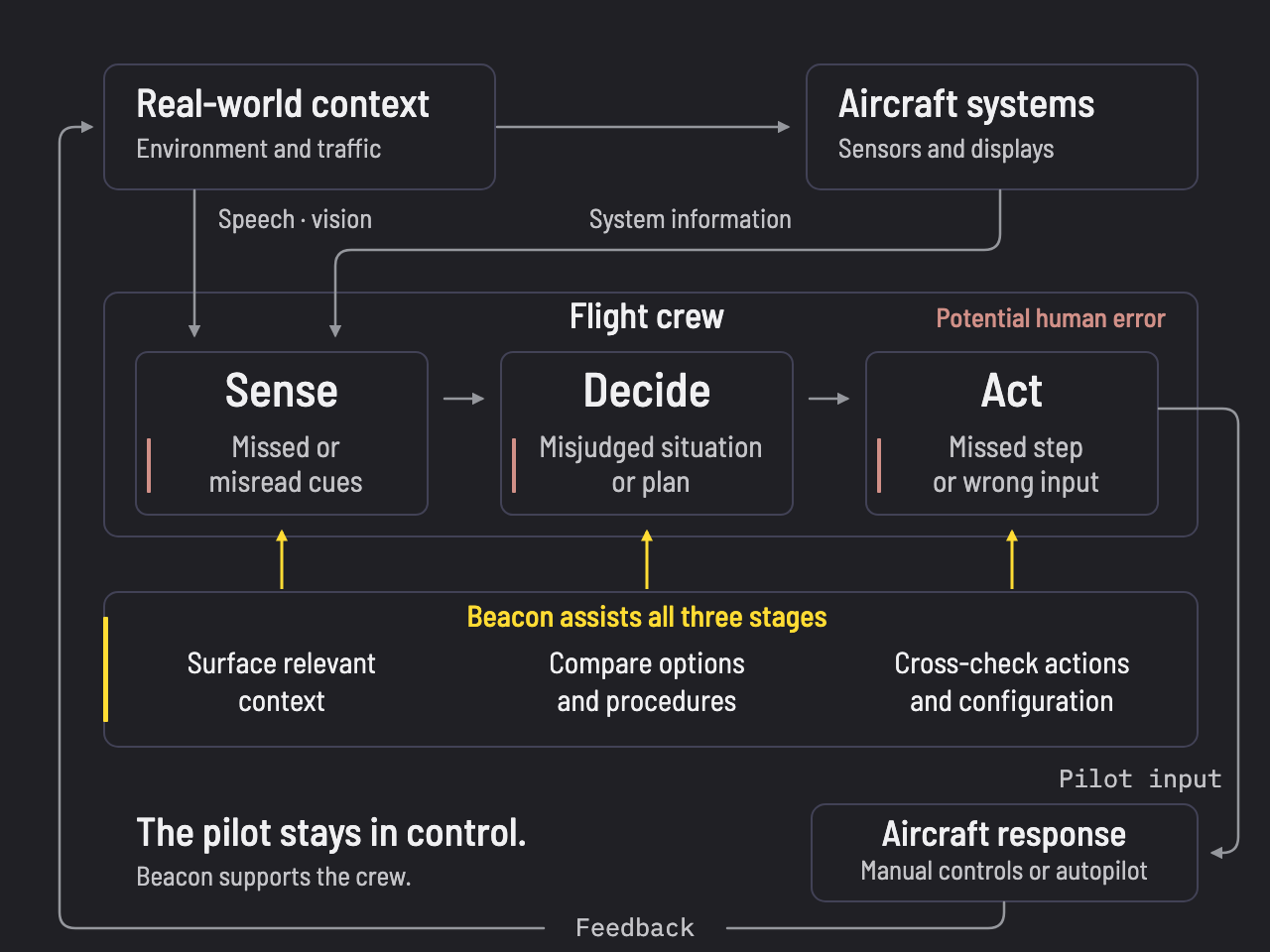
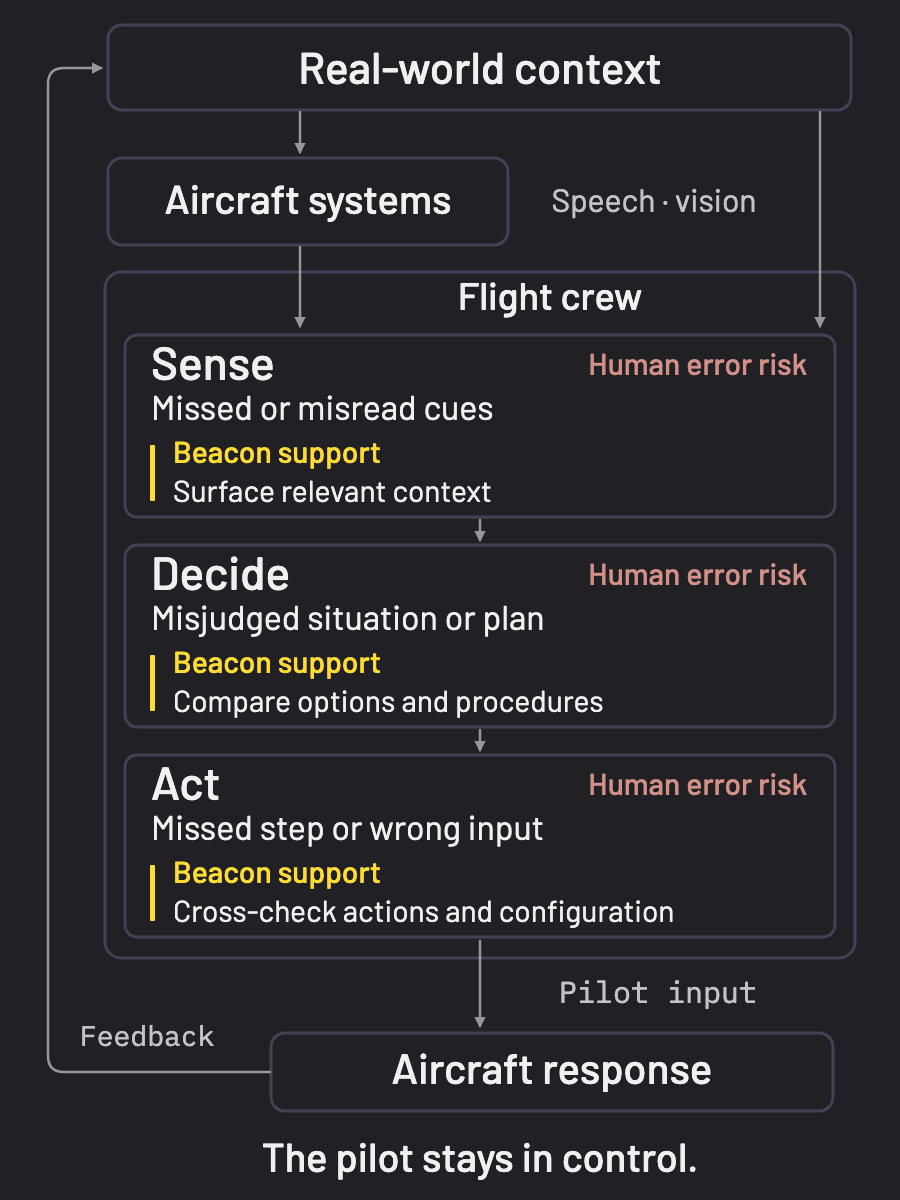
Aircraft systems execute defined functions. Crews still have to sense, decide, and act. Errors can arise at any of those stages. Beacon is designed to add context, guidance, and cross-checks across the human decision loop.
Six Levels of Aviation Autonomy
How much of the pilot’s role has shifted from the human to the machine?
Beacon’s six levels are its own scale, separate from SAE’s driving levels and EASA’s AI levels. At Levels 2 and 3, the pilot keeps full authority.
What Autonomy 1.0 Taught Us
Most aviation autonomy efforts go straight for Level 5, with a goal of removing the pilots. Those efforts, and the remarkable progress of self-driving cars, have taught four lessons that point aviation to Levels 2 and 3.
An Aircraft Can’t Pull Over
When a self-driving car can’t safely continue a trip, its fallback can be a safe stop. An aircraft in flight has no shoulder, and its only safe stop is a landing, so a trained crew stays at the center of every flight.
Certification Runs on Traceability
Aviation assures flight software under standards such as DO-178C, tracing implementations to written requirements. The FAA’s 2024 AI safety-assurance roadmap explains that learned AI implementations break this traditional traceability, creating new challenges for certification. In November 2025, EASA proposed AI-trustworthiness specifications and guidance in NPA 2025-07, including AI-based assistance and human–AI teaming. These proposals are still in the working group stage.
Real Context Comes From Real Flights
Test flights in fair weather can’t show everything crews face, and Europe’s aviation regulator expects AI to be built on data that represents the conditions it will fly in. Aviation already improves through de-identified safety data shared under long-standing protections. Pilot assistance gains that experience on real missions, with the pilot in command.
Safety Sets the Bar
Pilots have said they welcome technology when it makes flying safer. We build to that test. Pilot assistance answers to the pilot, who chooses when it acts and can override it at any time.
Remove the Pilot (Level 5)
Assist the Crew (Level 2 Now, Level 3 Next)
Replaced
In Command
A Handful of Company-Owned Test Aircraft
Operators’ Own Fleets
Limited. Test Flights, Mostly in Restricted Airspace and Fair Weather
Real Missions, in Whatever Conditions Crews Fly
Major Retrofits Throughout the Aircraft
Hardware-Lite: No New Servos or Flight-Control Changes
Presently, Would Require Significant New Rules, Special Conditions, or Exemptions
Established Approval Processes, Pilot in Command
Sources: SAE J3016 (2021); RTCA DO-178C; FAA Roadmap for Artificial Intelligence Safety Assurance (2024); EASA AI Concept Paper (2024) and proposed NPA 2025-07; FAA Advisory Circular 120-82; ALPA (2025).
The Pressure on Aviation Is Rising
Air travel keeps growing, and carrying it will take tens of thousands of new aircraft and hundreds of thousands of new pilots. Airlines do that work on thin margins, and a safety record that improved for decades has leveled off. Technology has to help, and the place to start is the crews flying today.
Demand
More Flying Every Year
About two-thirds of those pilots replace people leaving the profession; the rest fly a growing fleet.
Source: Boeing Commercial Market Outlook 2025; Boeing Pilot and Technician Outlook 2025.
Margins
Thin Margins for the Airlines Flying It
Of every 100 airlines McKinsey tracked in 2024, 36 earned more than their cost of capital.
As a sector, airlines' return on capital has stayed below their cost of capital since at least 1996.
Source: IATA industry outlook (June 2025); McKinsey & Company with IATA (March 2026).
Safety
Safer Than Ever, but Leveling Off
Fatal accidents per million commercial flights
The rate fell more than tenfold after 1970, then held near 0.3 to 0.5 for the past decade. With traffic set to more than double, it has to keep falling just to hold the number of accidents steady.
Source: Aviation Safety Network and ICAO, via Our World in Data.
Causes
As Machines Got More Reliable, Human Factors Took the Lead
Share of accidents by primary cause, illustrative
Early aircraft failed often, so most accidents were mechanical. As engines and airframes became far more reliable, the share traced to human factors rose to about 80%. Crews didn't get worse; the machines got better, and the hardest part left is the judgment crews exercise every flight.
Source: Illustrative curves after a United Airlines training graphic. The roughly 80% share today matches the sources on Home.
Who Flies
Uncrewed Aircraft Are Lost Far More Often
Flight hours per serious loss
Uncrewed aircraft give the U.S. military critical capabilities. Over the same years, Air Force uncrewed aircraft were destroyed about two and a half times as often per flight hour as the crewed types they were compared with. The two bars count different events, so read the gap as approximate.
Source: Congressional Research Service analysis of Air Force Safety Center data (R47067, July 2022), covering the Predator, Reaper, and Global Hawk; NTSB Part 121 accident survivability study (2020).
Ground Risk
People on the Ground Share the Risk
Syracuse, New York · June 25, 2020
An MQ-9 on a training flight lost all engine power seven seconds after takeoff from Syracuse Hancock International Airport and came to rest past the end of the runway. Investigators traced it to a fuel lever moved in place of the flap lever right beside it, a slip any well-trained crew can make. No one was hurt, but mishaps like this are costly: Air Force accident boards have valued lost MQ-9s at roughly $13 million to $26 million each.
A crash with no one aboard still puts the people below at risk. Large uncrewed aircraft have had only limited, case-by-case access to U.S. civil airspace, with regulators citing safety.
That risk applies to every aircraft. When a cargo jet crashed on takeoff in Louisville, Kentucky, in November 2025, more people were killed on the ground than aboard. The investigation has centered on fatigue cracks in an engine mount, a mechanical failure.
Source: Air Force Accident Investigation Board, via Air & Space Forces Magazine (2021); MQ-9 loss valuations from Air Force accident reports, via Task & Purpose; GAO-08-511 (2008); NTSB investigation DCA26MA024 (2025–2026). Flight profile is schematic, not to scale.
The Idea Was Right, and the Technology Has Caught Up

In the 1980s, DARPA and the U.S. Air Force developed the Pilot’s Associate to help fighter pilots plan missions, assess threats, and monitor aircraft systems. Historians of the program describe the vision as a kind of R2-D2 for the cockpit. It showed real promise, but the technology around it wasn’t ready: the computers, sensors, data links, and cockpit displays of the day couldn’t keep up. One 1988 demonstration took about three hours to compute 30 minutes of simulated flight.
Self-Driving Built the Toolkit
By 2022, industry estimates put investment in self-driving technology at more than $100 billion. That work produced sensors, computers, and data tools aviation can now adopt. Lidar, a laser sensor that cost about $75,000 a unit in 2007, now comes in car-grade versions for a few hundred dollars.
AI Computers Got Small, Fast, and Rugged
In about a decade, compact AI computers built for robots and cars became hundreds of times more powerful, and rugged versions now weigh a few pounds.
Tablets Earned a Place in the Cockpit
Since 2011, tablets have gone from novelty to authorized tool, on airline flight decks under FAA guidance updated in 2017 and 2024 and on military flight decks under the services’ own approvals.
Satellite Communication Got Better
Low-Earth-orbit broadband satellites fly dozens of times closer than geostationary ones, cutting in-flight delay from roughly 700 milliseconds to tens of milliseconds. Major airlines have committed thousands of aircraft, new networks keep launching, and the Department of War has raised its contract ceiling for these services more than tenfold.
The Cloud Opened to Aviation and Defense
Since 2019, the FAA has shared near real-time airspace data for analysis through commercial cloud. The Department of War now buys commercial cloud services across every classification level, and large AI models have been authorized in government clouds since 2024.
Self-driving cars, robotics, satellite broadband, commercial cloud, and physical AI have together drawn hundreds of billions of dollars of investment and built tools on a scale aviation couldn’t reach alone. Murdock puts those tools to work in the cockpit and Lighthouse across the fleet, on a principle that hasn’t changed since the U.S. Army flight-tested a pilot’s associate in the late 1990s: the assistant suggests, and the pilot decides.
Sources: Roland and Shiman, Strategic Computing (MIT Press, 2002); Good Science Project (2024); Rotorcraft Pilot’s Associate program releases (1998–99); McKinsey & Company as reported by the Financial Times (2022); Brookings Institution (2017); IEEE Spectrum (2018) and industry reporting (2024–26); FAA Advisory Circulars 120-76D (2017) and 120-76E (2024); Ookla (2025); airline, FAA, and Department of War announcements (2019–26); company filings on cloud and AI infrastructure spending (2024–25). The computing comparison uses peak manufacturer ratings at comparable precision.
What Congress Asked For
In its FY27 NDAA report, the House Armed Services Committee directs the Department of War to brief it by February 1, 2027 on its plan to evaluate, transition, and adopt AI-enabled assistive technologies for air crews. The briefing must cover four things.
Beacon’s pilot assistance autonomy is built for this approach: software-centric, hardware-lite, and designed to work with the aircraft’s certified systems.
Sequencing and Scaling
A plan to sequence and scale these capabilities, including the operational and cost benefits of software-centric solutions over hardware-intensive direct aircraft control.
Governance and Policy
A senior official or organization to coordinate Department-wide policy, requirements, airworthiness alignment, and cybersecurity for software-centric technologies.
Airworthiness Approvals
How the Department’s current airworthiness approval processes apply to AI pilot-assist capabilities.
Evaluation and Platforms
FY27 and FY28 plans for experimentation or limited operational use, listing the platforms, mission sets, and criteria for safety and readiness.
Questions We Hear
Straight answers for pilots, passengers, operators, and anyone who lives under a flight path.
Hasn’t This Been Tried Before?
Yes, in the 1980s, when DARPA and the U.S. Air Force developed the Pilot’s Associate. The idea was right. The compute, sensors, connectivity, and data it needed didn’t exist yet, and neither did the software and AI to use them. Now they do.
Isn’t This Just a Better Autopilot?
No. Autopilot holds heading, altitude, and airspeed, and it follows the plan it’s given. Deciding what the plan should be, and catching what goes wrong, still sit with the crew, and mistakes there can be catastrophic. Crews are skilled and well trained, and they’re also human, like the rest of us, so they deserve more help. Beacon works in that reasoning layer, beside the crew. On the six levels above, autopilot is Level 1. At Level 2, Beacon advises the crew. Level 3, the next step, adds actions the pilot approves.
Why Not Replace the Pilot?
Because no one can yet, for three reasons. Even the best autonomy today isn’t ready to be the only pilot on board. Even if it were, the rules wouldn’t allow it. And even if they did, the high-context data it would need, from real missions in real conditions, doesn’t exist yet. Pilot assistance autonomy makes crews more capable today, and becomes more capable, complete, and reliable with every flight.
What Does This Mean for Pilots?
Beacon keeps the pilot in command and adds another set of eyes. It works as a safety net that catches errors before they become accidents, a coach that reinforces good technique, and extra capacity when the workload spikes.
What Does Hardware-Lite Mean?
Helping the crew without new servos, and without modifying certified flight-critical systems or replacing avionics, flight controls, or actuators. Beacon adds a modern computer, sensors, and a crew display that work with data the aircraft already produces. At Level 2, it advises the crew. At Level 3, it can also act on the crew’s behalf with the pilot’s consent, through the aircraft’s existing systems. It’s the approach Congress describes in the FY27 NDAA report, and the FY26 report encourages the military to prioritize hardware-lite, AI-enabled pilot augmentation.
Can’t the Military Just Fly Without Pilots?
In restricted airspace, largely. But much of military flying, from transport to training, shares the national airspace system with airliners and follows the same kind of rules. Those aircraft need crews, and those crews benefit from the same help.
Isn’t Pilotless Cargo the Easy Case?
Not as easy as it sounds. A large freighter is built to the same airworthiness standards as the passenger version of the jet, and all-cargo airlines fly under largely the same airline rules. The main differences are a big cargo door, how the main deck handles fire, and the reinforced cockpit door that passenger jets must carry and freighters don’t have to. With no passengers aboard, most of the risk, aside from the crew, sits on the ground. Major cargo hubs sit next to cities, and when a cargo jet crashed on takeoff in Louisville in November 2025, more people died on the ground than aboard. Even small drones, which carry no one and pose relatively little risk to people below, have taken more than a decade of careful rulemaking to approach routine flight beyond the pilot’s sight.
Isn’t This Self-Driving for Planes?
Aviation suits AI assistance well, for different reasons than driving. A driver may have milliseconds to react; a flight crew usually has seconds to minutes, so advice arrives in time to use. Aircraft already carry thousands of parameters on certified data buses, and their flight controls are already certified. In the air, the hard part is judgment: weather, fuel, diversions, degraded systems. That’s the part Beacon works on.
The Aviation Autonomy Series
The thinking behind Autonomy 2.0, written by Matt Cox and published in parts. Each part builds on the last.
We’re working with commercial and defense partners to bring pilot assistance autonomy to the flight deck. Let’s talk about what that looks like for your operation.
